Showing posts with label advice and note-to-self. Show all posts

Sunday, June 28, 2026

Post-Teaching Thoughts

Here's how the dance that taught me to improvise also taught me how to teach.

Two weeks ago, my friend, Mark Bissel of Seraphim Dance, asked me to sub for his class for one Saturday. I retired from teaching FCBD-style ATS nearly a decade ago after struggling to build a regular student base and eventually becoming disillusioned.

Mark is an accomplished dancer and a familiar face in the Southern California belly dance community, having performed throughout the region and organized the Renaissance Faire Middle East stage for years. So I wasn't surprised to see his classes thriving.

The class that I needed to sub was week three of Level 1. I'd attended the first two sessions and noticed regulars (five to six people). So, I'd expect the same regulars to come to the class I was subbing, and we could review the previous moves and add more fast steps and slow moves to vocabulary (we were supposed to learn Forward Back Shimmy with half and quarter turns, and Propeller, Corkscrew, and Reverse turns).

Lo and behold, only three people showed up. The first two were practically complete beginners in FatChanceBellyDance ATS, one of them actually stayed after the earlier Zumba class. The third one who came a bit late was a more experienced dancer who's been taking Mark's class regularly. 

I knew I wouldn't be able to review the previous steps and moves from the previous two classes. I'd overload the newcomers with information, and they wouldn't be able to actually just enjoy a dance class. 

I panicked. 

I'd done a run-through of the lesson plan the night before. I'd rehearsed it and felt good about it. 

But then I remembered: ATS is all about improv. Why shouldn't that include being flexible when it comes to teaching and rolling with the punches? 

I pulled from my experience teaching non-ATS bellydance classes at gyms, and I told myself I could do this. 

In the first 10 minutes, we focused on posture and slow moves that I consider essential: Taxeem, Floreo, and Arm Undulation. 

Posture (and dance angle) is important because this is the foundation of belly dance, and most importantly ATS. Having the correct ATS posture minimizes the risk of injury and reveals the secret of maximizing the range of movement (the softer your knees, the bigger your Taxeem and Bodywave). 

After the students were able to get the hang of Taxeem and Arm Undulation, we moved on to Bodywave. Bodywave is probably one of the best moves to introduce beginners to bellydance, while not alienating the more experienced dancers because it's always a good time to revisit the mechanics of Bodywave. Plus, it's the gateway to Rhythmic Undulation.

Now we have Taxeem, Floreo, Arm Undulation, Bodywave, and Rhythmic Undulation. 

And it's time to move on to shimmies.

Shimmies are a great way to get the body moving, and it's also one of the hardest fast steps to master. ATS shimmies are what Raqs Sharqi dancers call "three-quarter shimmies." We started slow and then built up the speed. Now we have the Basic Shimmy. 

Time to add the steps that would turn the Basic Shimmy into the Forward Back Shimmy.

After the Forward Back Shimmy drills (we even did the half turn and quarter turn variations), we still had fifteen minutes. And we decided to cool down with the Corkscrew Turn and Propeller Turn. 

And for the last drill, we were able to put everything together. 

Here's the Tl;dr takeaway: 

  1. It's week three (or week four or whatever). None of your regulars shows up. Instead, you have drop-in beginners. Be flexible and tap into your ATS improv roots.
  2. Teach them the essentials: posture, dance angle, Taxeem, Arm Undulation, Floreo, Bodywave, as well as easier fast steps that could be used as a transition (in this case, we used the Rhythmic Undulation and Basic Shimmy).
  3. Depending on how receptive the students are, try to teach that week's lesson plan (we were supposed to learn Forward Back Shimmy, Corkscrew Turn, Propeller Turn, and Reverse Turn) without alienating drop-in beginners. Shimmies are excellent because we can build Rhythmic Undulation Shimmies and Forward Back Shimmies on top of the Basic Shimmies. It's always a crowd-pleaser because it gets the body moving and is challenging. 
  4. Dancing a full song of follow-along ATS is completely feasible after the students know the week's lesson plan. Mix it with the transition fast steps they just learned (in this case Rhythmic Undulation and Basic Shimmy) to get out of the fast steps in the lesson plan (Forward Back Shimmy plus its variations). 
All in all, I was relieved that Mark's regulars didn't come. If they had been present, I'd be even more torn about alienating the two drop-in beginners and making their experience with me not so pleasant.

Did not seeing Mark's regulars retraumatize me and made me question my worth as a teacher? Of course! For a moment, I was back to sitting in my own empty class, week after week, month after month. But I decided to give them the benefit of the doubt: Maybe something came up and they weren't able to come. After all, LA is vast and it was a Saturday. 

At the end of the class, I told them Mark would come back in the next session and that I was only subbing. My two drop-ins both said they wished I would teach because they enjoyed the class. 

It was an amazing thing: being complimented after a long dry spell.

But I don't think I want to come out of full retirement from teaching just yet.

Join Mark's classes on Saturdays at 12 noon (10642, Lower Azusa Rd, Temple City, CA 91780; the Google Street View was taken in 2017, it's the one that says "Qin Mobile Device Repair").

Mark also teaches on Tuesday evenings at the LA Bellydance Academy in North Hollywood.

Monday, March 30, 2026

Twelve Years

It has been twelve years since I last posted to this blog. A lot of things have happened: Tribal Fest dissolution, Covid-19, and FatChanceBellyDance no longer having a physical presence in its birthplace of San Francisco.

I had a blog post draft in 2017 entitled "Four-Year Itch," where I wanted to write about how I wanted to take a soft retirement from ATS. I was disillusioned by the ATS dance scene in Los Angeles. My inability to find students was a large contribution, as well as a disastrous sword performance. 

Los Angeles is a city of hustlers, and I don't hustle enough or have the knack to hustle. 

Still, it hurt me when a studio asked someone else to teach ATS, even if I had teacher certification and they didn't. Even if I lived five minutes away from the studio and that person didn't. Even if the studio owner knew me. 

Still, I took the classes because I enjoyed dancing ATS. 

Fast forward to 2026, and I'm a student again. I want to say I don't think I'll ever be a good enough teacher, or at least have enough students. And I've made peace with the idea of always being the bridesmaid and never a bride. 

American Tribal Style bellydance is still big in parts of the US and parts of the world. It's never going to be as big as other forms of dance, including its big siblings, raqs sharqi and tribal fusion, and I've made peace with it too. 

Being a student has its own advantages. You wouldn't need to contend with the anxiety of rejection or having to cover studio fees because nobody showed up to class. This acceptance came with age as well. 

If you're looking for American Tribal Style classes in San Francisco, my good friend Yuka Sakata still teaches pure FatChanceBellyDance ATS every Saturday and every other Tuesday. Go to her website here

If you're looking for American Stribal Style classes in Los Angeles, Mark Bissell teaches FCBD ATS in East LA

Thursday, October 17, 2013

street fairs

One thing that I like about dancing in the US is that we get to do street fairs. In Indonesia (well, I don't know about Bali), bellydancers are typically not that well-regarded. And people who go to street fairs here are generally laid back. Blue Diamonds Belly Dance, student troupe of FatChanceBellyDance® has been doing lots of street fair gigs lately, and I danced in two of them in my 'hood (Rockridge and Berkeley).

Here are some tips.

Sometimes you'll be dancing on asphalt. So wear appropriate footwear. I was tempted to wear my Asics running shoes, but the soles are too grabby, and since I don't wear skirts, my footwear shows (especially when I'm spinning), so in my opinion, sneakers kind of ruin the aesthetics.  I used to have a pair of gold gladiator sandals, but they were so cheap and not made for dancing that they broke apart after six performances. Then I bought another pair of gladiator sandals, but they made my ankles bleed. And one time, one of them came off mid-performance, and it was really stupid.

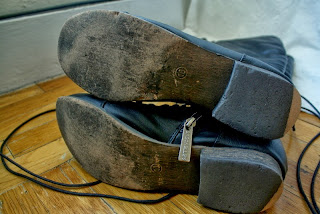
Then I found these awesome knee-high boots on eBay. These are vegan boots by Breckelles. At first I thought they were so slippery, and I don't like the way they clack clack clack when I'm walking, but turns out, the soles are not grabby, and they're perfect for dancing on pavements and asphalts.


Then there's also the issue of dancing in sunlight. Our performance time for both fairs was at 1 PM. So yeah: the sun is relatively right above you, which is kind of good since you don't have to turn and spin and bam! the sun is right in front and blinding. But that also means that you'll get tired more easily (what with the headwraps / turban / head gear, and squinting is really exhausting), so don't wear too much jewelry like I did at Berkeley Sunday Streets. Seriously, I almost could not keep my elbows up in the final song of the first set (we danced to two sets). I got home and out of curiosity, I weighed my bracelets that I wore to the Berkeley gig, and I realized I was wearing 2.7 pounds of jewelry on my arms. Yikes. But it's a good work-out for your shoulders, back, and delts. 


Now about squinting, and this is probably just the shape of my eyes, I really don't like the way my eyes sort of disappear in action shots. So you may want to consider eye make-up that makes your eyes look big even as you squint (is that even possible?). And no, I'm not talking about this: 


Finally, cover-ups. With a shining sun and a typical Bay Area breeze, I'd recommend wearing assuit / tulle-bi-telli. The cool metal keeps your body temperature low. But if it's too cold, then use something else. 


Oh, ignore her. That's just Kate Moss.


Thursday, May 30, 2013

an artist's attitude

My admiration for Zoe Jakes is apparent. I adore her spins, her pops and locks, her make-up, her jewelry, her energy. She is a skilled dancer and theatrical performer.

In my previous post, I've written about how I felt elated when she said that a piece of jewelry she wore was Javanese. That particular blog post is about cultural appropriation and what I think about it. Then yesterday, I saw this video.


I am not an authority on Balinese dance (or any traditional Indonesian dance), but I've seen enough Balinese dance performances to notice there's something that doesn't sit well with me.

Let me tell you, I am not offended by this performance, and to be honest, I think this is one of the ways to promote Indonesian dance. I mean, Colleena Shakti has consistently done this with traditional Indian dance and I know that Odissi is gaining popularity what with Sonia Ochoa, Moria Chappell, and one of my dear friends Allison Mulroy going to Ms. Shakti's school in Pushkar, India to learn Odissi. Traditional Indonesian dance is a dying art form. As an Indonesian, I can't help but feel somewhat guilty about this, because I am not interested in learning any traditional Indonesian dance (largely because most of these dances require discipline and hard work and they have really intricate footwork and arm work, and I'm just too stupid. I quit Kathak after only four sessions).

I know there are Balinese dancers or those who are well-versed in this dance form who will probably be offended, so I think it's only fair to mention that Zoe Jakes and Marci Ann have been studying with Gamelan Sekar Jaya (I don't know for how long). (Addendum: click here for further explanation from the person who helped Zoe choreographed this piece.)

Now back to my gut feeling: I don't mind the headdress and the costume (I don't know if there's a religious significance attached to them), but some movements don't gel with the gamelan music. For example, the "Floorwork Body Dive" at 1:14 to 1:26; The pop, lock, and little drops that Zoe does at 1:44 to 1:49 and the chest shimmies at 1:42. I don't know whether or not these movements are in the Balinese dance vocabulary, but they somehow don't look right.

I am not trying to be diplomatic nor kiss ass, and maybe I'm just insensitive and have the tendency to sell-out, but I don't feel that my culture is being appropriated by this performance. It intrigues me and makes me feel uncomfortable, but not offended.

One of my closest ATS® dance friends and I had a discussion about this video performance, and we both agreed on one thing: the artist attitude. When I was an undergrad working on my degree in advertising, I had a professor in Copywriting class who kept telling us that we were not artists, that we still had to keep in mind how the audience (or the client) would perceive our work. I think that keeps me in check with my own approach in trying to create a choreography. For some people, this may mean less freedom, but it also may also mean giving value to (and therefore respecting) the audience. The thing is, I don't know if people (who have authority on an art form or a religion or a culture) will criticize an artist's performance simply because of the artist (diva worship). Not criticizing the artist, not presenting the artist with an opposing view point (not necessarily negative), is actually bad for the artist's growth.

I like to equate this to a bad red carpet dress choice. Many celebrities have had their hits and misses. Many celebrities have had their phases of bad dresses. Some have survived and become fashion icons, some are still trapped in that phase. They might have survived because they listen to those who shook their head and said, "Honey, don't." They might have survived because they saw their pictures and shook their head and said, "I can't believe none of my friends told me, 'Honey, don't'!" But here's a counter argument: who's to say what's garish and what isn't? Who's to say what works and what doesn't? I don't like too skimpy and transparent clothes on the red carpet, but some people may call me prude.

Paige Lawrence, the director of the Uru Tribe, wrote a very poignant Note on his Facebook page. It's a reflection of the Uru Tribe's journey to Tribal Fest 13, and how he feels about his own performance. Sometimes we are our own worst enemy, and sometimes it's a good thing, because it may mean we are constantly trying to evolve, to grow, to challenge ourselves, to come out of our comfort zone. I still cringe (A LOT) whenever I see videos of myself performing.

Here's hoping that people won't see Zoe Jakes and Marci Ann's performance at Tribal Fest 13 as a true and authentic representation of Balinese dance. I know the introduction says "inspired", but we all know things can get lost and murky in translation.


Friday, April 19, 2013

new(ish) notes on teaching

Last December, Tribal Babes Indonesia hosted the second annual Tribal Bellydance & Fusion Festival where I gave a three hour workshop called ATS® Sampler Platter.


To be honest, creating a workshop is so much like editing: it's really, really hard. Workshop is about picking and choosing things, what will work, what won't, what will bore the shimmies out of the participants, what will match the overall level of the dancers, but most definitely, what you want your participants to take away from your workshop.

Teaching ATS® is something new to me. During my time in the US, I've only been a student, and I enjoy doing that. I enjoy having that somewhat carefree attitude: I'm here to learn, and not to teach. I mean, I do have the responsibility to improve my skills (which include not only my posture and techniques, but also musicality and how I interact with other dancers on and off the stage - to some degree).

Here's the thing, ATS® is also something new, if not foreign, in Indonesia. The Indonesian belly dance scene is still heavily saturated with Cabaret / Oriental, which I also love, but perhaps will no longer be performing, except perhaps for Fusion. Tribal Fusion is also trending right now, but some dancers are not exposed to what "Tribal" really is. The whole concept, and that is the leading and following concept, is something unheard of. However, leading and following is the very essence of ATS® and I want to get that point across.

I talked over the phone with Ms. Nericcio during the week when she was teaching in Michigan. I told her the dilemma I was facing: I would like to keep it interesting and challenging (because somehow I'd thought that the mentality of the Indonesian dancers was to gain the most in terms of quantity and repeating and drilling the same moves over and over again would bore them to death) while teaching them what "Tribal" stands for in American Tribal Style® (and its offshoot - Tribal Fusion).

Here's the gist of what she said: keep things simple.

I told her that the Sampler Platter class was designed to have three sessions. The first one focuses on Slow Moves (first and foremost the Puja, then posture, arm placement, Floreos, Arm Undulation, Taxeem, Bodywave, and probably throw in some fancier stuff like Reverse Turn or Corkscrew Turn depending on how fast the participants could absorb the more basic moves). The second one is all about Fast Steps (Egyptian, Arabic, Pivot Bump, Shimmy, and Turkish Shimmy). The third one can either be a review of all the Fast Steps and Slow moves or a Shimmy drill (which I love).

At Mihrimah's workshop two years ago, she did a very cool thing where we would form a chorus, and one by one, we would come in from the left, move to the center, lead the whole chorus for a couple of eight counts, then fade to the right so the next person could take over. That was really fun and inspiring and I tweaked it a bit to match the ATS® concept.

At the end of each session, I would pair two dancers in a duet and have them dance together for one song, to review the moves on their own (they wouldn't need to worry if they made mistakes - I told them to be confident and that they was to always follow the leader), then the participants would form a chorus, and each duet would dance as featured dancers for a while.

This seemed to work at my last workshop. I mean, obviously I couldn't get the participants to have the perfect posture and techniques (heck, even I am still learning), but I managed to get the Tribal point across.

Ms. Nericcio's advice was this: get people excited. This was particularly true. I remembered how the lifted elbow posture was especially excruciating but the participants seemed to enjoy it, part of it was because they felt challenged. Once people are hooked, they will become curious and want to learn more.

However, there are also those who just want to get introduced to ATS® and see if it's really for them or not. This is fair game. I had a lady who asked me in my workshop, why we only did Pivot Bump on the right hip. She said that it would not train the muscles on the left hip. Carolena's advice for this one was to let them know that using the left hip does not complement the ATS® aesthetics and concept (leader on the front left). Also, bumping with the right hip doesn't mean that we're not exercising the left hip. Both right and left obliques are being used. Based in my experience, my Pivot Bump gets bigger if I also engage my left oblique muscles every time I release my right hip. I hope this makes sense.

One thing for sure, though: Puja is an essential aspect of ATS®. It helps ground the dancers and remind us of our roots. This is why I always start each session and end the third and final one with a Puja.

I can't wait to go back again to Jakarta and share the beauty of American Tribal Style®.


Friday, November 09, 2012

taking care of silver

Just recently, I was lucky enough to come into possession of an antique Rajasthan style waist belt. It's exactly the size I'd wanted, and the price was not ridiculous (when I say "ridiculous", I mean out of my reach - I know how expensive silver can be, but I also know what "overpriced" means). So I made a few some many sacrifices and purchased it.

When I finally received it, I was a bit disappointed and alarmed. It didn't look as silver as it was in the pictures. It looked yellowish, almost bronze-like. I thought I'd been duped. I could return it within seven days, but I decided to clean it, and some other silver jewelry, with baking soda and aluminum foil. The water residue of the belt was so ghastly and murky, but it was not enough. The belt still looked bronze and I was still worried.

But I was determined to clean it. And so after consulting The Great Interwebz, I ordered this polishing cloth. It came in the mail this morning and I just finished cleaning my belt.

Here are the photos.


The waist belt. 


The yellowy tarnish on the clasp was still there even after the baking soda and aluminum foil cleaning. 

Some rub using the polish cloth, and hello clean old silver. 

I'm comparing my contemporary Indian sterling silver bracelet with the antique waist belt, still uncleaned.

The bracelet, compared with the back of the belt's clasps that has been rubbed with the polish cloth. 

A comparison of the bracelet, a part of the belt's been cleaned, and the part that hasn't.

And after 100 minutes of rubbing and scrubbing and buffing (I was watching Lord of the Rings: Return of the King while doing this), look, look, look: it's silver. It's shiny, shiny silver. 

The belt and the dirty, dirty polishing cloth. 

Now it's time to store it so it won't tarnish in a short while. I bought these little zip lock bags

And anti-tarnish paper tabs. These work like silica gel. 

And they're all protected inside the zip lock bags. I place the jewelry that I wear often in a separate bag. 

Also, as a double (or is it triple?) protection, I place them inside this bag that's made of cloth that has R-22 to prevent tarnish. 

One last note, I also ordered  3M Tarni-Shield polish, but it will arrive next Monday and I just couldn't wait to clean the belt. There are still some deep parts that need cleaning and the crevices too deep to reach. I'll clean it again using the Tarni-Shield and old tooth brush. Perhaps it's wiser to clean it first using the Tarni-Shield (or whatever chemical polish) - if your jewelry piece has tarnished too much, so that it will make the job of rubbing and buffing a lot easier. 

All of these might seem excessive and too much, but consider this: you've spent hundreds if not thousands of dollars collecting silver or gold jewelry. I always see precious metals and stones as investments - their value most likely increases over time, so why not take good care of them? God forbid one day we have to part with them, but if the time comes, and they've been well taken care of, then they will sell for a price as beautiful as the jewelry themselves. 

Make time to clean your jewelry, at least wipe the sweat and oil off your accessories when you take them off and store them in the anti-tarnish bag or storage. 

Addendum: The Tarni-Shield has arrived and I used it to clean the belt with an old tooth brush to reach for the deep parts. It worked just fine, although I prefer cleaning my silver jewelry using polishing cloth.

The lower buckle was cleaned using Tarni-Shield and tooth brush and the upper buckle wasn't.

Also, I'm now going to wrap my silver pieces individually in acid-free white tissue paper and then store them in the zip lock bags and R-22 bags.

I'll do the same to my Assuits and I'll share how that turn out later. 

Sunday, November 04, 2012

notes on performing ATS® solo

So, obviously I have tons of homework to be done (and I haven't updated my Pink in California blog for a long time now), but I just can't find the motivation to do so.

Although I like to multitask, I feel that I can do better if I work on one thing first (the one on the top of the priority list and work myself down - well, most of the time) and dedicate my time to it. And this blog entry has been waiting quite a while.


The thing is, whenever I'm back in Jakarta for end of semester vacation, I don't really have anyone to perform ATS® with, so I have to do a solo. At the end of every solo performance, though, I've always become sad because well, American Tribal Style® is never meant as a solo piece. No one told me this, but I used to believe the only person allowed to do ATS® solo is Ms. Carolena Nericcio. But then from time to time, I saw videos of FatChanceBellyDance® troupe members soloing when there're just two or three of them dancing together for a set.

Still, as much as I love performing, for me, ATS® solo was not something I looked forward to. It just didn't feel right.

That's why I'll always remember one recent Saturday when she said in class that even when we were dancing solo, we weren't dancing alone. We have the chance to engage the audience, to dance with them, to invite them in, to include them in our dance. And this can be done through our face and body angle. Always smile and not only with the lips, but also the eyes. Don't squint but slightly open your eyes and let your eyes smile too.

This was a great light bulb moment for me. And I hope this makes sense to you too.

I mean, yeah, I've heard of the concept of engaging the audience when dancing in a group - always maintain eye contact and smile and such, but this kind of falls into the wayside whenever I'm soloing. I didn't think of "dancing" with the audience. I always thought about dancing for the audience.

Speaking about engaging the audience, Sensei Kae also stressed how important it was to always engage the audience whenever we're dancing, even in a Dueling Duet formation when it's easy to be too engrossed in whoever's leading. We can do this by making eye contact whenever we pivot or do a Move or Step that faces the audience.

There's another important note. I've always thought the Arm Undulation (whether layered with Taxeem or not) and Body Wave were beautiful movements, but away from the stage, they could be really subtle, too subtle for a dramatic impact. Ms. Nericcio pointed this out yesterday. Dramatic slow songs (Stamena, Aicha, Arawan) instantly beg for level drops, turns, and laybacks, but that doesn't mean we can't do many of these when dancing to other types of slow songs. Use Arm Undulation (with or without Taxeem) and Body Wave for fillers, for transitions, for moments for the audience to breathe and clean the audience's palate, so to speak. And when you're doing these subtle movements, our body needs to be really articulate, and this means two things: clean technique and the knowledge of all the mechanics of the movements.

Then I remembered that one time I saw a video of my performance and thought how boring my Arm Undulation was, no matter how much I enjoyed performing it and thinking how good it must've looked. Haha.

I'm just going to close this blog entry with this awesome video (I think I put it on the blog one time, but it's just so good).


Sunday, September 23, 2012

where i stand on this cultural appropriation thing

First of all, let's just make it clear of what I mean with "cultural appropriation".

noun /əˌprōprēˈāSHən/ 
appropriations, plural
  1. The action of taking something for one's own use, typically without the owner's permission; the appropriation of parish funds
  2. The artistic practice or technique of reworking images from well-known paintings, photographs, etc., in one's own work
  3. A sum of money or total of assets devoted to a special purpose
These definitions are from Google Dictionary. For this case, let's discard the third definition and add the word "cultural" in front of it, thus making the meanings of "cultural appropriation" something like this: 
  1. The action of taking someone's culture or subculture, typically without asking for permission from those who are culturally or subculturally related or understand said culture or subculture. 
  2. The artistic practice or technique of reworking art (including but not limited to: dance and movement composition, literary composition, musical composition, visual composition like painting - mixed media - jewelry design - graphic design - tattoo - pottery - sculpture) in one's own work. 
For the first definition, many have also added that those who culturally appropriate belong to the dominant cultures (typically the Caucasian), but sometimes, I don't think that's the case. 

The thing is, during my free time, I don't go out and take long walks or run or enjoy the great outdoors. I'm not an outdoors person. The sun ruins the skin. During my free time, I browse the internet. Sure, I get caught in the weird part of the Internet from time to time, but anything's wonderful as long as I don't come across pictures or stories of animal abuse. 

Time and again, I found posts that disrespect (that's a really pejorative term in many cases) belly dance, its culture and origin (which no one really knows), and those who perform the dance. 

Time and again, I found posts that disrespect (again, that's a pejorative term) American Tribal Style® and or Tribal Fusion belly dances. 

Let's focus on the Tribal bashers (the Trishers? Tribashers?). What's really disheartening is that if you go on forums like Bhuz or Tribe.net, you'll see Oriental style dancers bashing Tribal, saying that Tribal is not belly dance. And it's cute (okay, it's not) when you see that in some of their posts, these dancers refuse to call themselves bellydancers because they think the term "belly dance" and "belly dancers" are demeaning. They do Middle Eastern dance. They do Oriental dance. They go to Egypt or Turkey to study with the greats and try to keep the art form intact. They don't like the term "belly dance" yet they tell Tribal dancers to use whatever name but not belly dance. 

But wait, turns out, these Oriental dancers actually use "belly dance" to promote their work, albeit with a cringe, because it's easier to get their point across. 

I won't discuss that in detail and I don't really pay attention to those posts because, well, the posters have made themselves look and sound ignorant. 

The thing that really gets me is the constant telling that Tribal style belly dance and especially ATS® are considered cultural appropriating. 

Okay, I get it. ATS® has indeed borrowed lots of elements from different cultures across the globe. The Puja for one is an adaptation of East Indian prayer, then Megha Gavin from Devyani Dance Company expanded it (I don't know Ms. Gavin that well, but I do know that she is knowledgeable in Indian culture and philosophy) and FatChanceBellyDance® adapted the extended Puja, which I have yet blogged about. I'M SO SORRY. IT'S COMING ALONG!

Then there's the jewelry (Afghani, Yemeni, Pakistani, Kohistani, Turkoman, Kuch), make-up (facial tattoos inspired by the Berber, the Ouled Nail; bindis from Indian culture), costume (India, Middle East), music selection (too many to mention, from folkloric Bedouin to contemporary Balkan to modern beatboxing, and we play finger cymbals too), and of course the dance itself.

Full disclosure: I'm an ATS® belly dancer. I don't have that much money, but when I do, I use it to take dance classes and buy dowry (which includes jewelry and costuming bits and pieces).

For the jewelry, again, since I don't have that much money but I need to get that chunky, more is more look, I sometimes have to opt for cheaper jewelry. I mix and match cheap and plain silver bangles with the monster ones that I've carefully tried to research. I own several pieces of Assuits, only one of them is more than fifty dollars including shipping. My prized possessions include a Tuareg spike and dome ring that I bought from my friend, the amazing dancer/photographer/hair-flower-creator Shelly Swanegan Hamalian, a gold-washed Turkoman ring from Sirik.com, a Carol Felley cat with Amethyst ring (my birth stone is Ruby, but I'm really drawn to Amethyst), and a silver hip chain from NakaRali (I bought this one at TribalFest 11 and I'm still broke now). I wear the cat ring because I'm crazy about cats. Plus, it's silver, it's huge, and it fits in the more is more aesthetics.

For facial tattoos, I use the chin line and the three dots near the outer corner of each eye. I stopped wearing the dots over my eyebrow because I learned that it's used for Indian brides. I'm not a bride, nor am I Indian, although you know, when (I'm not using "if") John Abraham proposes, I'll be one, and y'all are invited to the wedding. In this video, Ms. Nericcio clearly states that bindis and facial tattoos in ATS® are purely ornamental. Also, go here for more information on facial markings

I wear turban when I dance because my hair is short (and I've a small head) and I need something to stick the flowers on. Also, as androgynous as I want to be, men do wear turbans, and in a way, my turban can both conceal and show that I'm a dude. 


Does that make me, an ATS® belly dancer, a cultural appropriator? I guess for some people, yes. But I do know my limits, because I know which elements I need to use, which elements I can go without, and not only because of aesthetic reasons. Having knowledge and information on the things we wear and create (and for some, the things we eat) is one of the ways to adopt a culture and promote its beauty. If you go to FatChanceBellyDance® studio, you'll see stacks of books about tattoos and jewelry and textile. Those ladies, especially Ms. Nericcio, know their trade.

ATS® is not an authentic representation of Middle-Eastern dance. That fact was established a long time ago. Some people are ignorant of that, and that's also another fact. So let me write this again: ATS® is not an authentic representation of Middle-Eastern dance. 

But many ATS® dancers (I'm not saying all) are well aware of the origins of the jewelry they wear. Some of them can even point the places out on the world map. Some have even been there. These dancers help expose the world to a culture rich with tradition and exquisite jewelry (and then some), which means more production, more income, and eventually more revenue to the craftsmen and the overall tourism industry. 

At the Indian and Vedic Culture miniseminar several months ago, Ms. Colleena Shakti said that the NakaRali silver supplier and craftsmen had doubted that their products would sell well in the USA (and subsequently, the world), because they had low demands in India. More and more young people in India prefer the more modern (and sometimes cheaper) jewelry. This stroke a chord. Many Indonesians, I for one, don't wear traditional clothings or promote the traditional jewelry, which by no means is less exquisite than Indian jewelry. 

In Evolutions: The Exotic Art of Tribal Bellydance, Zoe Jakes talks about her costume and jewelry inspiration. One of the pieces she wears is a heart-shaped pendant from Java. Is it a religious symbol? I don't think so. What if it is? Should I care? I don't think so either. Is she culturally appropriating one culture from my country? Maybe. But here's what I do know: when I heard Zoe said "Javanese", my heart leapt with pride. She's an international performer and I don't care that I sometimes don't like her style, but she promotes something from my homeland. Also, every time I hear songs that incorporate musical instruments from Indonesia, I feel honored, I feel respected.

Heck, I was ELATED when I saw Kecak dance in The Fall (frigging awesome movie, by the way. Very beautiful, very strange, very surreal, very emotionally exhausting, with Husband #16 Lee Pace in it). 

Also, another thing. There's this Tumblr blog that bashes people wearing Native American headdress. I get it. The thing is, the same writer said that he celebrated Halloween, which is a Celtic tradition and is nowadays commercialized (like Christmas and Easter and the Eid). So, double standards? 

My friend Julia sent this link to a great article (the conclusion is, it's hard to draw the line as to what exactly is "cultural appropriation", but the rule of thumb is to not wear something that has a deep symbolic meaning like a war bonnet, nor something that has religious meaning like the Rosary, and always make sure that the craftsmen get respectable cut because, well, they need the money to keep producing those gorgeous items. By the way, in terms of turbans vs. war bonnets, you know, many turbans are worn because of the functional purposes). 

Well, I'm beat. I was supposed to do my homework, but I really felt that I needed to get this one out first. 
***

Man in orange and green turban photo is taken from Pink.City.Mag and check out its page on Turbans!

Photo of Carolena Nericcio by Kristine Adams

Photo of me taken by Shelly Swanegan Hamalian.

Sunday, September 16, 2012

folkloric look for ats®

All I knew (and this was said repeatedly whenever we had classes that focused on creating a folkloric look) was that generally, when one wants to dance ATS® to a folkloric music (with the mizmar, oud, doumbek, without any of the synthesized sounds), complete with the vintage head wrap and tassels, it is best to maximize the folkloric look by staying away from swirly, swishy moves. This categorization had eluded me for so long (a year, probably), but last Saturday, I finally received the answer. 

Ms. Sandi Ball gave me the permission to copy this list. I've added some that weren't on the original list (look for the asterisk). 

Folkloric Look:
  1. Egyptian (I assume this means all variations of Egyptians, including Triple Egyptian, but excluding Egyptian Sevillana since this has a more Flamenco feel to it)
  2. Arabic (but not Arabic Hip Twist nor Arabic Hip Twist Flourish and its later descendant: the Alabama Twister)
  3. Pivot Bump
  4. Choo Choo
  5. Shimmy (including the variation with a slight dip on the one in every four counts. Since the Shimmy is a two-count move, it goes like this: one - two - one - two - one - two - one - two - one - two etc. The underlined is when you slightly dip) 
  6. Turkish Shimmy (including Quarter Turn and Half Turn, but excluding Turkish Shimmy with Arms & Turn)
  7. Arabic Shimmy (excluding Arabic Shimmy with Arms & Turn)
  8. Reach & Sit (well, this one comes from the Tahtiyb / Stick dance, so it works well with songs with Saidi rhythm)
  9. Up 2 Down 3
  10. Double Bump & Single Bump
  11. Shoulder Shimmy
  12. Wet Dog
  13. Ghawazee Shimmy
  14. Reshamka
  15. Chico Four Corners
  16. Ribcage Rotation
  17. Head Slides
  18. Circle Step*
  19. Camel Walk*
  20. Corkscrew, Propeller, Reverse Turns*
  21. Torso Twist*
  22. Circle Step*
  23. Bodywave*
Modern Look: 
  1. Arabic Hip Twist and Arabic Hip Twist with Flourish and the Alabama Twister
  2. Turkish Shimmy with Arms and Turn
  3. Arabic Shimmy with Arms and Turn
  4. Double Back
  5. Sahra Turn
  6. Wrap Around Turn
  7. Barrel Turn
Now, obviously this list is ever evolving. For example, the Water Pot from Devyani or The Box Step and Push Forward Push Back from the Ghawazi Caravan vocabulary are not on the list. Granted, the Water Pot is swishy and swirly (meaning it has lots of turns and spins), but it does have that folkloric look. In my opinion anyway. And the Push Forward Push Back and Box Step have that folkloric hard edge. 

Also, I believe Floorwork falls into the Folkloric Look category. 

One of the main reasons I post this is to remind myself that there are moves that are considered Folkloric Look. When I dance, especially when there's mizmar or any kind of wind instrument that's not droning, I like doing the swishy steps like the Arabic Hip Twist. So, the list gives me a kind of boundary in a good way. 

I was going to include a YouTube snippet of The Tattooed One, but instead, I'm just going to post this.

When I stumbled upon it, it was like opening a treasure chest. Seeing Ms. Nericcio's fast solo is a rare treat too. 


Sunday, September 02, 2012

le moroccan six

I rarely get the opportunity to take a class with Ms. Marsha Poulin. Come to think of it, I think I've only taken one class with her once way back last year or earlier this year. Yesterday was my second ever. She taught us the Moroccan Six zil pattern. 

Before I begin, let me give you a full disclaimer: I took piano lessons from when I was five years old to when I was fifteen. Ten years. And I still didn't know how to play anything if it's not on the C Major scale. I have a really bad musicality and my eyes and fingers just can't coordinate that well and I just couldn't (can't?) commit the songs into my muscle memory. Learning to play finger cymbals is and always has been a challenge. I was first taught how to play the zils by Ms. Maria Aya when I was in Greece back in 2008. She taught me several patterns including the Triplet and the Baladi. It wasn't hard, but that was because we were sitting down. At that time, even moving the arms and walking while playing the zils was hard. 

In ATS®, however, only two patterns are used regularly: the RLR and the Military. The Military is only used for Up2Down3 and Double Back while a slight variation is used for Push Forward Push Back. Sometimes Ms. Kristine Adams or Ms. Sandi Ball would drill us on Baladi pattern and Moroccan Six, but yesterday, we really focused on the Moroccan Six.

You can listen to Moroccan Six pattern in Moroccan Six (duh) by Helm in Tribal Dance - Tribal Drums album or Ishwini Fik, also by Helm in their Spice Box album. As you might have guessed, there are six beats in a measure, instead of the regular eight, so although Moroccan Six and Ishwini Fik can be considered as up-tempo, two things won't fit: RLR pattern and Fast Steps. That means, only Slow Moves can be performed to these songs. However, not just any Slow Moves. Ms. Poulin advised us to do Dramatic Slow (fancy turns, Floorwork, Layback, Dueling Duets) to songs with a Moroccan Six pattern.

While the featured dancers do their things, the Chorus backs them up with a special zil pattern called, you guessed it, the Moroccan Six. All six beats must be acknowledged by playing the zils on each beat but only the first and fourth beats are accented (played louder). Then play another six beats on the zils evenly (without accent).

This is the written pattern: R - L - R - L - R - L - R - L - R - L - R - L

The bold and underlined letters are the accents.

Now, as opposed to the RLR or Military zil patterns, the Moroccan Six should be played a bit muffled. The Chorus is already in a Slow Move mode, so arms are down (with the elbows lifted as always), and the hands  are in the position where the thumbs are above the rest of the other four fingers. You know, like when you're gathering water to wash your face. Let gravity bring down the zils on your thumbs to the ones below, which are resting above the middle finger and (as in my case, because my zils are quite big) the index and ring fingers. This will make the the ziling sound more muffled.

One more thing: featured dancers don't need to play the zils when dancing to a Moroccan Six song. And if the dancers in the Chorus aren't confident enough to play the Moroccan Six, then don't. A little tip: start slow, then build the speed.

Here's FCBD® and Devyani dancing to Ishwini Fik.


Saturday, July 28, 2012

what ATS stands for

Let me say this up front: I am a perfectionist. I've blogged about this and some of you are tired of me whining about this, but really, I'm cringing every damn time I see a video of myself performing ATS®. 


Well, actually, I cringe not only whenever I see videos, but also photos. I'm not talking about the flabby midsection (although that's a huge problem, pun intended). I'm talking about the A, T, and S in ATS®, which are:
  1. Attitude: no ego, know when and how to lead, know when and how to give up lead, know when and how to follow, no drama, no bullying, no seniority, no jumping on pedestal, no belittling. 
  2. Technique: no floppy arms, no floppy wrists, no hunched back, no sunken chest, no unclear cue, no unclear shimmy, no zoning out, no low energy level. 
  3. Smile: neutral smile for Slow, big, toothy smile for Fast. 
I'm lacking in all those. 

I'm working on my smile, though. Anyone who's ever met me knows that I don't have a perfect set of teeth and I always try my best to conceal my teeth (I've been doing that for more than twenty years, so my jaws have muscle memory of their own), and smiling during ATS® Fast is always a killer.


And about the negative list above (maybe some will think it's demotivational since the list has so many no-nos and I didn't try to word it out more carefully using positive phrases), well, the list is for myself and I'm not being too hard on myself (HAHA I just wrote "hard on"), I just don't want me to misrepresent ATS® that I know. 

I'm almost relieved that there's no photo of me doing ATS® at Taqsim Festival: Semarang.


Taqsim Festival: Bandung. Just Tribal Fusion workshop. 

July 2012 saw me and the velvetRAQS director, Ms. Mifta, traveling to two cities in Java. That was the first for me. Ms. Mifta already has lots of out of town workshop experience. We did Taqsim Festival in Semarang (Central Java) on July 9th and Bandung (West Java) on July 21st. The Taqsim Festival in Semarang had both workshops and hafla while we only did workshops in Bandung because it was held on the first day of Ramadan. Then I went to Bali for vacation on July 26th, and a friend was hosting a small hafla and I also danced there. On July 1st, I danced at TAQSIM: the celebration of Oriental and Tribal belly dance, a hafla hosted by the velvetRAQS and Dancewave Center. I had been working on a drum solo by Drumspyder and I was confident enough to present it. 

I was absolutely wrong. 

First try on July 1st: Floppy arms, floppy wrists, weak shimmies, I messed up the Sunanda. 
Second try on July 9th: Floppy arms, floppy wrists, weak shimmies, too-low arm positions when doing Split Arm 2 (right arm above, left arm table top). 
Third try on July 26th: No more floppy wrists, but still floppy arms (although much better than the first and second attempts), more powerful shimmies, higher arm positions when doing Split Arm 2, but my arms were too frantic when doing Arabic Shimmy with Arms and Arabic Shimmy with Arms and Turns. 

Dancing in Bali: NO SMILE.
Ya know, I'm just trying to get a decent video here so I can upload it to our website. I guess it has to wait. 

I heard Rachel Brice videotaped herself when rehearsing. I believe it. 

Fortunately, I don't have to be all negative. I discovered this photo and I thought, hey, there's still hope. 

At TAQSIM: the celebration of Oriental and Tribal belly dance.
I'm leading the dancers in the finale. I wish I'd smiled this big during my real ATS® solo. 

Saturday, June 02, 2012

shimmies and shimmies

Ya know, it's a bit ironic that I call myself (on this blog anyway) "the boy who shimmies", and yet I find myself unable to shimmy properly, well, the Oriental shimmy anyway. However, when it comes to ATS® Shimmy, I feel very confident and at home.

Sensei Kae, Ms. Sandi Ball, and Ms. Wendy Allen all did shimmy drills on the course of two weeks. Beginning with Sensei Kae (another shimmy & spin class) on Thursday night (we also learned the tricky art of Over Shimmy), Ms. Ball on Saturday afternoon (have you ever seen how she flawlessly executes ASWAT? I have her tips below), Ms. Allen on Wednesday (I felt a bit adventurous and took the 51A bus to cross Oakland and Emeryville to Alameda where she teaches, then Sensei Kae again just a few hours ago (more shimmy drills).

So, okay... Here are the tips from Ms. Sandi Ball:

  1. To make your ATS® Shimmy even, if you're like me (my left shimmy is weaker than my right when I'm doing Turkish and Arabic Shimmy), then switch your focus from your right hip to your left hip. Concentrate on the left hip only. Your right hip is already shimmying big and nice and juicy, now it's the left hip's turn to get some lovin'. This was a lightbulb moment. It works for me. 
  2. When doing Arabic, there's this contrast going with your upper body (chest and torso) and arms. When the right foot steps down on one, think of stepping down but your upper body goes upward, like floating up, this is to get your chest to lift and your torso to undulate). Then as the left foot steps down on two, it's like your upper body (down to your hip, actually) sits down. On one, as the upper body goes upward, the arms plunge down in front of the body, then floats up on the side to over head from second to eighth counts. Add shimmies and you have Arabic Shimmy. 
  3. For ASWAT, this is how you achieve Ms. Sandi Ball's ASWAT flawlessness: as you're turning on fifth to eighth counts, keep your left hand near your left hip on five and six and left it float on seven and finish on eight. Letting the left hand sit there for five and six gives more aerodynamism, plus you won't hit your dance partners as you turn. 
This is one of my favorite videos, despite its lighting quality. Although I think the dark lighting adds the mood. 


Well, I'm blogging at San Francisco International Airport now, waiting for a grueling economy class flight back to Jakarta. I'm so sad to miss classes at the mothership for three months, but I'm glad that I closed it rather well: I got to dance with a guy! His name is Russ, he's from Seattle. He's at the studio for General Skills and Teacher Trainings. So that means... Another male joining the clan!

Sensei Kae just had to do the Shimmy drills. Then I had to drag two suitcases, each one weighing 23 kg (50 pounds), from my apartment on the third floor, all the way down, and walked five blocks to the bus stop. Then one block to the BART station. One of the suitcases contains Kali, Lilith's twin. I was a bit worried because I thought the suitcase containing Kali was oversized and Singapore Airlines has restrictions over the combined linear dimension of the suitcases. I even phoned their rep in SF, and I thought I had to pay USD 109, but it turned out fine. They checked in well. 

I'm so tired. I just want to find my seat (I get window seat this time, YAY!), get comfy, see the in-flight movies, and cocoon myself. 

I'll see you soon. I need to blog an addendum about ASWAT and Sunanda. 

Sunday, March 18, 2012

foot, elbow, face

Some Saturdays ago, Ms. Nericcio was there to teach the class. I was away in December and January and those were actually the months when she wasn't travelling and dedicated her time to teach (and observe). So of course came rain or high water, I went to the studio.

I know I'm still struggling with so many aspects of many of the moves and steps. I realized that I've been very, very bouncy. I mean, with the flailing arms and the bobbling head and everything, so I'm working on it. But Ms. Nericcio pointed out something else (well, not only to me, but to the whole class). She said she wanted to see a beautiful entrance when we're coming out of the Chorus to be the featured dancers.

Here's the checklist:

  1. Feet: Glide, don't walk. Long, supermodel steps. 
  2. Elbows: Lifted to convey a feeling of emphatic entrance. When you slide back in to the chorus, make yourself small so you can fit right back in, without dropping the elbows, of course. 
  3. Faces: Smile! Toothy smile when doing Fast Steps. You can also show your teeth when doing Slow Moves, but it's okay if you don't, as long as you smile. 

Here's a little video to emphasize on the three aspects above. 


I was late for two consecutive Saturdays and so I didn't have the time to tell the teachers (Ms. Allen on one Saturday and Ms. Lalwani on the next) that I was working on my bounciness. But after class, I asked Ms. Lalwani about this and she said that she didn't see me bouncing too much. 

So, yeah. I guess I can work towards a goal after all. Haha. Yay!


Saturday, January 14, 2012

well hello there, 2012

Alright, as usual, when I'm back in Jakarta, I hardly blog. I have reasons! As soon as I landed in Jakarta, the grueling practice sessions and rehearsals began, and I'm not kidding. A few hours after touch-down, I met my velvetRAQS girls and we practiced the two numbers that I choreographed for Dancewave Center's annual recital, The Dance Within 3D: One World. The sold-out show (yes, sold-out. Again.) was held in the legendary auditorium of Gedung Kesenian Jakarta (Jakarta Performing Arts Building) on Saturday, 7 January 2012.

Here are some photographic highlights from the show. Things weren't perfect (I'm trying to be modest) and by golly look at my bloated belly. Sigh.

I resolve to own six-pack abs for the next recital.

No, really. I do.


The pictures of the velvetRAQS in white Tribal Fusion attire (headdress, bra of the girls, my top, and my belt are all made by me) are of us dancing as Snow Flakes using choreographed moves from FatChanceBellyDance® vocabulary. I'm very proud of my posture as it totally slims down my belly. Haha. I wore my new Ivory Tulle bi Telli scarf from Safti Craft. I only have good things to say about Safti. Very timely production and shipment.

The second set of pictures are of us in black Tribal Fusion attire (my top and belt are made by me). I danced as Kali-Ma who slays the Three Goddesses of Time so Earth could return to her glory (before time, before humans exist).

I'm still waiting for pictures from the first Tribal Bellydance & Fusion Festival organized by Tribal Babes Indonesia, right the next day after The Dance Within 3D: One World, where I danced two numbers. I've got a really cool story for that evening.

***

Photo Credits:

Photos 1, 3, 4, 5, and 6 are by Diana Tri from PIKME Photography.
Photo 2 by Yudha Wiraghupta.

Saturday, December 31, 2011

2011

I would be remissed if I didn't write any review of the year 2011. However, I've done it on my other blog, the Pink in California. So you might want to head there if you're really, really, REEEEALLLY curious to know more about my life (you're such a stalker! But I like being stalked. So, HA.)

2011 marked the first time I've been away from my home (and my country) for a long period. True, I had a blast with EF at San Francisco and finally doing what I had been dreaming of doing since 2008: learning American Tribal Style® at FatChanceBellyDance®, and not only that, but I also had the opportunity to perform live with BlueDiamondsBellyDance, student troupe of FatChanceBellyDance®. Twice, actually. The second one with live music by none other than Helm (gasp!).

In the other blog, I wrote that I wanted to focus more on dancing and writing for 2012. I guess I need to be more specific.

What I really want is to further improve my American Tribal Style® skills and really making myself ready to teach it on my own, of course using the FatChanceBellyDance® format. As much as I love being in California (Californians are so friendly! NOT. Well, some are), I miss being at home, being in Jakarta, speaking Indonesian, and dancing with my troupe mates.

Well, here's to the good things and the bad things that occurred in 2011. And here's to hoping for a stronger, more beautiful self in 2012.

Sunday, December 04, 2011

breaking the brick wall

Yes, this is still about the brick wall.

Princess Farhana wrote an excellent article about choosing the music to dance to. I only have a few things to say about it.

The first one is: I agree with everything she wrote.

Whenever I see people who work hard to do what they do and do it so beautifully, I can't help but feel envious. I can never sing as good as Sarah Brightman or do melisma as precise as (the recorded) Beyonce. I was feeling nostalgic and watched Sister Act 2: Back in the Habit (RIP Mary Wickes) and I realized that, just like in the first movie, those people could sing well, and it broke my heart that when I tried to sing along, I marred the song.

The same thing also happened in writing. I'm not talking about the big, published names. I'm talking about my classmates. There were times when I just closed my eyes when they read their piece and then heard great lines and thought, "Crap! That was an awesome line! Why didn't I think of that?"

Then there's the dance.

There are dancers with clear and precise pops and locks (Kami Liddle, Ela Rogers, April Rose, Samantha Emanuel). There are the dancers with spins and turns to die for (Zoe Jakes, Petite Jamila). There are dancers with incredible gymnastic skills and flexibility (Rachel Brice, Frank Farinaro). There are dancers with killer shimmies (Amar Gamal, Alexey Paraschuk, Bozenka, Dondi Dahlin). There are dancers who are amazing choreographers (Jillina, Sabah Saeed). There are dancers with effortless grace (Colleena Shakti, Devi Mamak, Sonia Ochoa, Mihrimah Ghaziya, Maria Aya). There are dancers with such posture that command the room (FatChanceBellyDance, Tamalyn Dallal).


But most all, these dancers (and more whom I didn't mention) can move the way I want to move. Every time I see the pops and locks and every time I listen to songs that move me and inspire me to do the pops and locks and ticks, I get frustrated and hit the brick wall. Why? Because I can't do them.

Every time I listen to Bollywood songs and then get to my feet and want to move, I get frustrated and hit the brick wall. Why? Because I know nothing of Hindi moves and mudras and what have you.

There's a little Tribal get-together that Tribal Babes Indonesia hosts right the next day after The Dance Within 3D: One World. Cinzia di Cioccio of Les Soeurs Tribales is going to have a workshop and then she's going to dance in the get-together. I was asked to dance two numbers and there are already a million songs to choose from.

Finally, I chose two songs and just sent them to Desi, the organizer from Tribal Babes Indonesia. I told her that I was sending the songs to her so I could stop making it harder for me to choose the songs I wanted to dance to. By sending the songs, I could concentrate on practicing with the two songs. I'll be dancing an ATS solo for the first one and Tribal Fusion for the second one.

I'm taking Princess Farhana's advice. No matter how hard I want to do pops and locks and ticks, I'm going to do what I can do with my body, at least for now.
Related Posts Plugin for WordPress, Blogger...