Showing posts with label accessories and costumes. Show all posts

Thursday, October 17, 2013

street fairs

One thing that I like about dancing in the US is that we get to do street fairs. In Indonesia (well, I don't know about Bali), bellydancers are typically not that well-regarded. And people who go to street fairs here are generally laid back. Blue Diamonds Belly Dance, student troupe of FatChanceBellyDance® has been doing lots of street fair gigs lately, and I danced in two of them in my 'hood (Rockridge and Berkeley).

Here are some tips.

Sometimes you'll be dancing on asphalt. So wear appropriate footwear. I was tempted to wear my Asics running shoes, but the soles are too grabby, and since I don't wear skirts, my footwear shows (especially when I'm spinning), so in my opinion, sneakers kind of ruin the aesthetics.  I used to have a pair of gold gladiator sandals, but they were so cheap and not made for dancing that they broke apart after six performances. Then I bought another pair of gladiator sandals, but they made my ankles bleed. And one time, one of them came off mid-performance, and it was really stupid.

Then I found these awesome knee-high boots on eBay. These are vegan boots by Breckelles. At first I thought they were so slippery, and I don't like the way they clack clack clack when I'm walking, but turns out, the soles are not grabby, and they're perfect for dancing on pavements and asphalts.


Then there's also the issue of dancing in sunlight. Our performance time for both fairs was at 1 PM. So yeah: the sun is relatively right above you, which is kind of good since you don't have to turn and spin and bam! the sun is right in front and blinding. But that also means that you'll get tired more easily (what with the headwraps / turban / head gear, and squinting is really exhausting), so don't wear too much jewelry like I did at Berkeley Sunday Streets. Seriously, I almost could not keep my elbows up in the final song of the first set (we danced to two sets). I got home and out of curiosity, I weighed my bracelets that I wore to the Berkeley gig, and I realized I was wearing 2.7 pounds of jewelry on my arms. Yikes. But it's a good work-out for your shoulders, back, and delts. 


Now about squinting, and this is probably just the shape of my eyes, I really don't like the way my eyes sort of disappear in action shots. So you may want to consider eye make-up that makes your eyes look big even as you squint (is that even possible?). And no, I'm not talking about this: 


Finally, cover-ups. With a shining sun and a typical Bay Area breeze, I'd recommend wearing assuit / tulle-bi-telli. The cool metal keeps your body temperature low. But if it's too cold, then use something else. 


Oh, ignore her. That's just Kate Moss.


Friday, November 09, 2012

taking care of silver

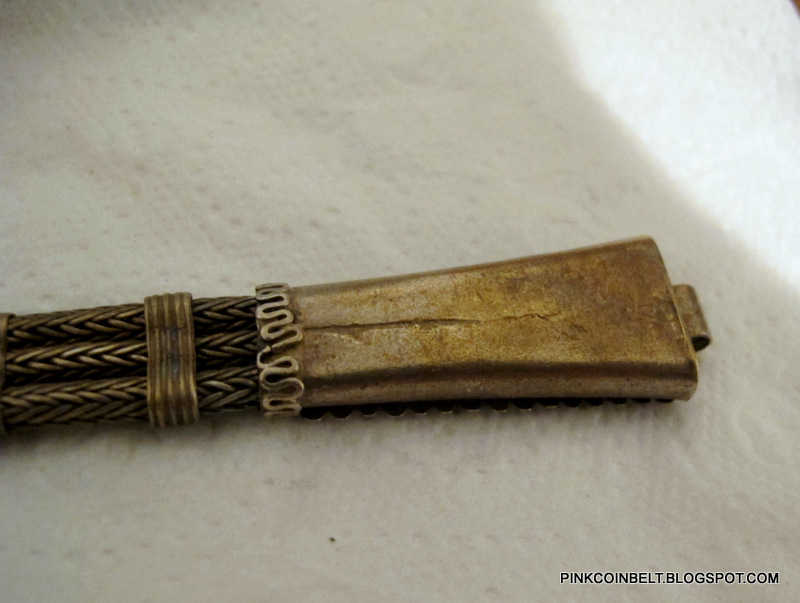
Just recently, I was lucky enough to come into possession of an antique Rajasthan style waist belt. It's exactly the size I'd wanted, and the price was not ridiculous (when I say "ridiculous", I mean out of my reach - I know how expensive silver can be, but I also know what "overpriced" means). So I made a few some many sacrifices and purchased it.

When I finally received it, I was a bit disappointed and alarmed. It didn't look as silver as it was in the pictures. It looked yellowish, almost bronze-like. I thought I'd been duped. I could return it within seven days, but I decided to clean it, and some other silver jewelry, with baking soda and aluminum foil. The water residue of the belt was so ghastly and murky, but it was not enough. The belt still looked bronze and I was still worried.

But I was determined to clean it. And so after consulting The Great Interwebz, I ordered this polishing cloth. It came in the mail this morning and I just finished cleaning my belt.

Here are the photos.


The waist belt. 


The yellowy tarnish on the clasp was still there even after the baking soda and aluminum foil cleaning. 

Some rub using the polish cloth, and hello clean old silver. 

I'm comparing my contemporary Indian sterling silver bracelet with the antique waist belt, still uncleaned.

The bracelet, compared with the back of the belt's clasps that has been rubbed with the polish cloth. 

A comparison of the bracelet, a part of the belt's been cleaned, and the part that hasn't.

And after 100 minutes of rubbing and scrubbing and buffing (I was watching Lord of the Rings: Return of the King while doing this), look, look, look: it's silver. It's shiny, shiny silver. 

The belt and the dirty, dirty polishing cloth. 

Now it's time to store it so it won't tarnish in a short while. I bought these little zip lock bags

And anti-tarnish paper tabs. These work like silica gel. 

And they're all protected inside the zip lock bags. I place the jewelry that I wear often in a separate bag. 

Also, as a double (or is it triple?) protection, I place them inside this bag that's made of cloth that has R-22 to prevent tarnish. 

One last note, I also ordered  3M Tarni-Shield polish, but it will arrive next Monday and I just couldn't wait to clean the belt. There are still some deep parts that need cleaning and the crevices too deep to reach. I'll clean it again using the Tarni-Shield and old tooth brush. Perhaps it's wiser to clean it first using the Tarni-Shield (or whatever chemical polish) - if your jewelry piece has tarnished too much, so that it will make the job of rubbing and buffing a lot easier. 

All of these might seem excessive and too much, but consider this: you've spent hundreds if not thousands of dollars collecting silver or gold jewelry. I always see precious metals and stones as investments - their value most likely increases over time, so why not take good care of them? God forbid one day we have to part with them, but if the time comes, and they've been well taken care of, then they will sell for a price as beautiful as the jewelry themselves. 

Make time to clean your jewelry, at least wipe the sweat and oil off your accessories when you take them off and store them in the anti-tarnish bag or storage. 

Addendum: The Tarni-Shield has arrived and I used it to clean the belt with an old tooth brush to reach for the deep parts. It worked just fine, although I prefer cleaning my silver jewelry using polishing cloth.

The lower buckle was cleaned using Tarni-Shield and tooth brush and the upper buckle wasn't.

Also, I'm now going to wrap my silver pieces individually in acid-free white tissue paper and then store them in the zip lock bags and R-22 bags.

I'll do the same to my Assuits and I'll share how that turn out later. 

Sunday, September 23, 2012

where i stand on this cultural appropriation thing

First of all, let's just make it clear of what I mean with "cultural appropriation".

noun /əˌprōprēˈāSHən/ 
appropriations, plural
  1. The action of taking something for one's own use, typically without the owner's permission; the appropriation of parish funds
  2. The artistic practice or technique of reworking images from well-known paintings, photographs, etc., in one's own work
  3. A sum of money or total of assets devoted to a special purpose
These definitions are from Google Dictionary. For this case, let's discard the third definition and add the word "cultural" in front of it, thus making the meanings of "cultural appropriation" something like this: 
  1. The action of taking someone's culture or subculture, typically without asking for permission from those who are culturally or subculturally related or understand said culture or subculture. 
  2. The artistic practice or technique of reworking art (including but not limited to: dance and movement composition, literary composition, musical composition, visual composition like painting - mixed media - jewelry design - graphic design - tattoo - pottery - sculpture) in one's own work. 
For the first definition, many have also added that those who culturally appropriate belong to the dominant cultures (typically the Caucasian), but sometimes, I don't think that's the case. 

The thing is, during my free time, I don't go out and take long walks or run or enjoy the great outdoors. I'm not an outdoors person. The sun ruins the skin. During my free time, I browse the internet. Sure, I get caught in the weird part of the Internet from time to time, but anything's wonderful as long as I don't come across pictures or stories of animal abuse. 

Time and again, I found posts that disrespect (that's a really pejorative term in many cases) belly dance, its culture and origin (which no one really knows), and those who perform the dance. 

Time and again, I found posts that disrespect (again, that's a pejorative term) American Tribal Style® and or Tribal Fusion belly dances. 

Let's focus on the Tribal bashers (the Trishers? Tribashers?). What's really disheartening is that if you go on forums like Bhuz or Tribe.net, you'll see Oriental style dancers bashing Tribal, saying that Tribal is not belly dance. And it's cute (okay, it's not) when you see that in some of their posts, these dancers refuse to call themselves bellydancers because they think the term "belly dance" and "belly dancers" are demeaning. They do Middle Eastern dance. They do Oriental dance. They go to Egypt or Turkey to study with the greats and try to keep the art form intact. They don't like the term "belly dance" yet they tell Tribal dancers to use whatever name but not belly dance. 

But wait, turns out, these Oriental dancers actually use "belly dance" to promote their work, albeit with a cringe, because it's easier to get their point across. 

I won't discuss that in detail and I don't really pay attention to those posts because, well, the posters have made themselves look and sound ignorant. 

The thing that really gets me is the constant telling that Tribal style belly dance and especially ATS® are considered cultural appropriating. 

Okay, I get it. ATS® has indeed borrowed lots of elements from different cultures across the globe. The Puja for one is an adaptation of East Indian prayer, then Megha Gavin from Devyani Dance Company expanded it (I don't know Ms. Gavin that well, but I do know that she is knowledgeable in Indian culture and philosophy) and FatChanceBellyDance® adapted the extended Puja, which I have yet blogged about. I'M SO SORRY. IT'S COMING ALONG!

Then there's the jewelry (Afghani, Yemeni, Pakistani, Kohistani, Turkoman, Kuch), make-up (facial tattoos inspired by the Berber, the Ouled Nail; bindis from Indian culture), costume (India, Middle East), music selection (too many to mention, from folkloric Bedouin to contemporary Balkan to modern beatboxing, and we play finger cymbals too), and of course the dance itself.

Full disclosure: I'm an ATS® belly dancer. I don't have that much money, but when I do, I use it to take dance classes and buy dowry (which includes jewelry and costuming bits and pieces).

For the jewelry, again, since I don't have that much money but I need to get that chunky, more is more look, I sometimes have to opt for cheaper jewelry. I mix and match cheap and plain silver bangles with the monster ones that I've carefully tried to research. I own several pieces of Assuits, only one of them is more than fifty dollars including shipping. My prized possessions include a Tuareg spike and dome ring that I bought from my friend, the amazing dancer/photographer/hair-flower-creator Shelly Swanegan Hamalian, a gold-washed Turkoman ring from Sirik.com, a Carol Felley cat with Amethyst ring (my birth stone is Ruby, but I'm really drawn to Amethyst), and a silver hip chain from NakaRali (I bought this one at TribalFest 11 and I'm still broke now). I wear the cat ring because I'm crazy about cats. Plus, it's silver, it's huge, and it fits in the more is more aesthetics.

For facial tattoos, I use the chin line and the three dots near the outer corner of each eye. I stopped wearing the dots over my eyebrow because I learned that it's used for Indian brides. I'm not a bride, nor am I Indian, although you know, when (I'm not using "if") John Abraham proposes, I'll be one, and y'all are invited to the wedding. In this video, Ms. Nericcio clearly states that bindis and facial tattoos in ATS® are purely ornamental. Also, go here for more information on facial markings

I wear turban when I dance because my hair is short (and I've a small head) and I need something to stick the flowers on. Also, as androgynous as I want to be, men do wear turbans, and in a way, my turban can both conceal and show that I'm a dude. 


Does that make me, an ATS® belly dancer, a cultural appropriator? I guess for some people, yes. But I do know my limits, because I know which elements I need to use, which elements I can go without, and not only because of aesthetic reasons. Having knowledge and information on the things we wear and create (and for some, the things we eat) is one of the ways to adopt a culture and promote its beauty. If you go to FatChanceBellyDance® studio, you'll see stacks of books about tattoos and jewelry and textile. Those ladies, especially Ms. Nericcio, know their trade.

ATS® is not an authentic representation of Middle-Eastern dance. That fact was established a long time ago. Some people are ignorant of that, and that's also another fact. So let me write this again: ATS® is not an authentic representation of Middle-Eastern dance. 

But many ATS® dancers (I'm not saying all) are well aware of the origins of the jewelry they wear. Some of them can even point the places out on the world map. Some have even been there. These dancers help expose the world to a culture rich with tradition and exquisite jewelry (and then some), which means more production, more income, and eventually more revenue to the craftsmen and the overall tourism industry. 

At the Indian and Vedic Culture miniseminar several months ago, Ms. Colleena Shakti said that the NakaRali silver supplier and craftsmen had doubted that their products would sell well in the USA (and subsequently, the world), because they had low demands in India. More and more young people in India prefer the more modern (and sometimes cheaper) jewelry. This stroke a chord. Many Indonesians, I for one, don't wear traditional clothings or promote the traditional jewelry, which by no means is less exquisite than Indian jewelry. 

In Evolutions: The Exotic Art of Tribal Bellydance, Zoe Jakes talks about her costume and jewelry inspiration. One of the pieces she wears is a heart-shaped pendant from Java. Is it a religious symbol? I don't think so. What if it is? Should I care? I don't think so either. Is she culturally appropriating one culture from my country? Maybe. But here's what I do know: when I heard Zoe said "Javanese", my heart leapt with pride. She's an international performer and I don't care that I sometimes don't like her style, but she promotes something from my homeland. Also, every time I hear songs that incorporate musical instruments from Indonesia, I feel honored, I feel respected.

Heck, I was ELATED when I saw Kecak dance in The Fall (frigging awesome movie, by the way. Very beautiful, very strange, very surreal, very emotionally exhausting, with Husband #16 Lee Pace in it). 

Also, another thing. There's this Tumblr blog that bashes people wearing Native American headdress. I get it. The thing is, the same writer said that he celebrated Halloween, which is a Celtic tradition and is nowadays commercialized (like Christmas and Easter and the Eid). So, double standards? 

My friend Julia sent this link to a great article (the conclusion is, it's hard to draw the line as to what exactly is "cultural appropriation", but the rule of thumb is to not wear something that has a deep symbolic meaning like a war bonnet, nor something that has religious meaning like the Rosary, and always make sure that the craftsmen get respectable cut because, well, they need the money to keep producing those gorgeous items. By the way, in terms of turbans vs. war bonnets, you know, many turbans are worn because of the functional purposes). 

Well, I'm beat. I was supposed to do my homework, but I really felt that I needed to get this one out first. 
***

Man in orange and green turban photo is taken from Pink.City.Mag and check out its page on Turbans!

Photo of Carolena Nericcio by Kristine Adams

Photo of me taken by Shelly Swanegan Hamalian.

Tuesday, January 24, 2012

indian jewelry and vedic culture

So last year (that's right, last year!) on October 5, FatChanceBellyDance® organized a miniseminar on Indian jewelry. The speaker was Ms. Colleena Shakti, the other half of Nakarali and Odissi dancer / teacher. I really don't need to tell you how fabulous Nakarali pieces are. I, err... I bought a piece of silver belt at last year's Tribal Fest and although it cost me an arm and leg, it's a good investment.

But I digress. Let's begin.

The beginning of Indian jewelry can be traced back to 5,000 years ago. The source of inspiration for the aesthetics came from the Vedas (ancient sacred writings of Hinduism). These Vedas have specific description of the adornments worn by the Gods and Goddesses (yes, I'm totally using capital "G"). These descriptions were made into illustrations by painters, and the poses of the Gods and Goddesses were translated by temple dancers into what is now known as Classical Indian Dance. This style of Indian dance is considered the epitome of Vedas, and therefore Indian, culture. The detailed carving of a God or Goddess or dancer from 500 years ago shows the exact same jewelry worn now.

What's remarkable is that every part of Chakra is covered in jewelry. This means there is a specific placement of each jewelry piece. Placing precious metals on the Nadis contains the power / spirit of the Mother / Goddess, therefore binding the Shakti energy.

The Indian idea of divine beauty is adornment. There is no end of adornment in the Indian aesthetics. The purpose of the body is to be adorned. Even in Kama Sutra illustrations (the classic ones, not the FHM ones) and sculptures, the clothes come off, but never the jewelry.

Jewelry also serves as an identity to show the caste and community. The 10,000 year old culture of India is passed on on both conscious and subconscious levels. The style of adornment reflects which tribe the person belongs to. Communal-mindedness is necessary in a tribe; there is no such thing as a stand-outness. Tribal costume (and jewelry) is not just adornment, but a lineage of ideas. The idea is how to represent people for having a pride in the moral system.

For example, the children of Kalbeliya Tribe, a caste of snake charmers, wear beaded jewelry (lighter, more comfortable, cheaper). When the girl is ready to be married, then she will wear silver that weighs at least 1.5 kg on her body. This is for financial security. Imagine, the people in this tribe lead nomadic life. This means no wall, no indoor plumbing, and now ATM. So if you had USD 5,000, where would you put it? On your body!

Jewelry is investment (like the belt I bought), it's also a transferable asset (you pass it down to the future generation), and it even guards you. Ms. Shakti told us the story of her Mataji who had an accident. Her leg was run over by a car, but she was alright because she was wearing a big-ass chunky anklet. The anklet protected her from too much damage, but it was broken to pieces. So they took the anklet to a shop to be sold to cover the hospital fee. The jewelry pieces are not pure or 92% silver, but they have to be mixed with other metals to endure the harsh conditions the tribespeople live in.

The Kalbeliya women are beggars, but they're adorned in jewelry and that's their right. The jewelry is not meant to be given up to feed the family (I know, right? THE IRONY). Sometimes, these people carve their names on the jewelry, like they have their names tattooed on their forearms because they're illiterate. Nowadays (I guess this also happens in Indonesia), Indians don't want to wear the older, more classic jewelry because they want to appear more western.

I was feeling rather intelligent that night and so I asked a question. The illustrations show Gods and Goddesses adorned in gold, so why is it that silver is the big thing? These are Ms. Shakti's responses:
  1. Gold is more precious (more expensive) than silver
  2. Silver mixes better with nickel and other metal
  3. Gold is reserved for Gods and Goddesses therefore distancing mere humans (Silver) with Supreme Beings (Gold - representing Solar energy)
I hope I didn't leave out important details! I'm sorry it took so long to write this. Sigh. Now that one debt is done, I still have two articles to post: Male ATS costuming ideas and the Extended Prayer.

Friday, October 07, 2011

dress like an egyptian

I forgot the time I first fell in love with an elusive piece of fabric called Assuit / Assiut / Asyut / Tulle-bi-Telli. However, like so many things Egyptian (their reverence of cats, the jewelry, the pharaonic scale drama, the eyeliner, the dark and handsome men), I've come to fall in love with this fabric.

This is going to be weird, but I just bought fortune-worth loads of books that I'm using as references for my (hopefully) up and coming novel. In one of the books, The Cat in Ancient Egypt by Jaromir Malek, it is said that:

"The earliest known remains of a cat in Egypt come from Mostagedda, south of Asyut in Middle Egypt, and are dated to sometime before c.4000 BC. One of the graves in this cemetery contained the burial of a man who, judging by the tools and other material accompanying him to the next world, probably was a primitive craftsman. The bones of a gazelle and a cat, the former probably intended for his funerary repast, the latter perhaps his pet, were found at the dead man's feet. (p. 45)"
I know there's something sinister with the Egyptians, or rather humans, in that when they're dead, they expect their loved ones to follow suit, hence the killing of the cats, the entombing of lovers, etc. In Classical Cats by Donald Engels, the Celts also killed cats by roasting them slowly in a basket to ensure fertility, a horrifying tradition that was later adopted by the English and the French (pp. 128-129). Perhaps the inhumanity of humans is so innate that at times I wonder what makes us think we can be called humans indeed.

But, I digress.

Let's get back to the subject.

After a long, dwindling fascination I had with Assuit, not unlike the fascination I had with Banjara skirts, and after a few unsuccessful eBay bids, I found this site: Nilemarket.com. It was selling quite a few Assuit shawls, including one cream with gold metals and one black with silver metals, each for the mere price of... drum rolls please... USD 35. So, I ordered those two shawls and a golden Ankh necklace. Sounds like a perfect bargain? Wait, here's the catch: Nilemarket ships from Egypt.

I cleared the payment for my package on September 12, and the next day, I received a notification that my purchase was shipped. I contacted the seller about the tracking number straight away (because there was no mention of the tracking number on the notification), but my e-mail wasn't answered. I used the website's inquiry form, and still no answer. I was worried and half-pissed, but then Haitham (the seller) replied my e-mail and provided me with the tracking number. He also wrote that the number would become visible once my parcel landed in the USA. So, I waited.

I waited, waited, waited for about ten days, each day opening the USPS website to track my package, and then one fine day, the USPS website said something else other than its usual: No record of this shipment, check back soon. It said: Origin post is preparing shipment. That sounded strange. That sounded like it was still in Egypt. I asked the omniscient Google and it confirmed. Still, I decided to wait.

Then ten more days passed, and me being the paranoid that I am, checked the USPS website every single damn day. And it stilled showed the same message: Origin post is preparing shipment. So I shot Haitham another e-mail, concerning the fate of my package. I also grew worried because I learned that some mails from the USA to Egypt had been experiencing difficulties due to the uprising in Egypt (but this issue was later resolved, thank goodness), so I thought that the same thing might have occurred the other way around. Haitham was at first unresponsive (like the first e-mail), and I also used the form to ask him the whereabouts of my parcel. Then he finally responded and told me not to worry because the package would arrive within the week.

There is one thread on Tribe.net about Nileart / Craveegypt, which I think is / are the same with Nilemarket for two reasons: the eBay page of Nileart / Craveegypt sell the same things with, or at least using the same photos of Nilemarket and if you look at Nilemarket's contact page, the e-mail that says @nilemarket.com will link to @craveegypt.com if you hover on it. In the Tribe.net thread, one purchaser wrote that she was happy with the purchase, although she had to endure a long wait (19 days). Here's the link. So, I took solace in it.

Then two days after Haitham responded my e-mail with warm consolation, the package arrived. It appeared out of nowhere on the desk in the building's lobby. I touched it and the inside felt soft, like layers of cloths. I was also expecting another shipment of clothing, so I didn't think it was my Egyptian parcel. However, I was in a rush to go to school and my bag was packed as it was so I put it back on the table (I also didn't have time to run upstairs to my apartment and place it inside). It was during a very boring lecture at school when I was approached by an epiphany: it had got to be my parcel from Egypt because my other package would have been a lot thinner! So the day went by so slow because all I could think about was to rush home to open it.

When I finally arrived home (it takes me a good one hour of commute with bus and BART and bus where it takes only ten minutes by car), I grabbed the parcel that was still waiting on the lobby desk and examined it as I climbed the stairs briskly: It had Arabic markings. My heart raced. Then once I'm in the safe confinement of my room, I opened it, and here they are, my first Assuits, 21 days after the payment:


Oh, and the weird thing is, up until this very day, the USPS website still displayed the same message when I tracked my package: Origin post is preparing shipment. I stumbled across another, more detailed tracking website called Track-Trace.com and up until now, it displayed the information that it had been sitting in the Cairo customs office since September 22, 2011. Don't believe me? Type in RS002330044EG (the tracking number of the parcel) and see for yourself.

Monday, September 26, 2011

skirts

A few months ago, I got connected to a male ATS dancer, the first male to ever receive the Teacher Training 2 certification for the FCBD format. His name is Valizan. I shot him an e-mail, asking him about the costuming guidelines for male ATS dancers. He told me about two more dancers, one of them is Michael McElhaney (formerly of Azure Bellydance, the first male ATS dancer, and part of FCBD student troupe in the nineties). Michael's name came through quite a few times during Teacher Training 2 where we discussed male ATS dancers, and both Ms. Nericcio and Ms. Sandi Ball agreed that he was very handsome. Valizan sent me Michael's photo and I had to concur.

In our e-mail exchange, I told Valizan that I was envious of the fact that our dance sisters could wear skirts that accentuated their movements (have you ever seen ATS dancers spinning while wearing the full, 25 yard skirts? It's a gorgeous sight to behold!) and he told me to try one of those Banjara Skirts.


So, thanks to Valizan (he's the male dancer in the video above that showcases how awesome Shades of Araby is), I caught the Banjara Skirt bug. After many months of the fever, I finally relented and began my quest for the perfect skirt. Tribal Fest 11 came and went and still the skirts were too Goldilocks-and-the-Three-Bears for my taste (too blue, too red, too orange, too many colors, too little colors, too wide, too short, too expensive, too new, too old, and other toos). Then I scoured for many nights and days (mostly nights, therefore sacrificing my precious sleep time) for the perfect one. If I had to be broken in, it must be perfect.

My trusted Amazon.com didn't have anything, and so, with a heavy heart, I opened an eBay account. Then I found Sirik's store. It's like a candy shop for kids, a sex shop for lonely adults, a sequin shop for Cabaret Oriental dancers. It has so many things to offer for ATS dancers, and then some. And I saw it. The Skirt.

Alas, it was still quite expensive (USD 89, plus USD 10 for shipping and handling), so I retreated. From time to time, I stalked Sirik's page, looking at the beautiful thing (and some others), and then it happened.

A 30% discount. So I bought it without thinking more.

After a few hassles (Erec, Sirik's owner, didn't respond to my initial messages asking for the tracking number, and then during my search on the Interwebz, I realized that the USPS Priority Mail didn't offer tracking number unless requested - and there's a fee for that; I ended up not knowing when the package would arrive, and finally received a notification in my mail slot that the package was waiting for me in a nearby USPS office), at long last, I received it.

And yes, it is beautiful. Despite the initial mixed-up, I highly recommend Sirik. He replied to my other messages with genuine concern, so yes, there is a good chance that I will buy from him again.


Saturday, August 06, 2011

lilith's new scabbard

The one thing I missed when I went to San Francisco was my scimitar, Lilith. I was (still am) clueless about taking a weapon, albeit a dull one, on an international flight, into a country as paranoid as the USA. I'm still shuddering every time I remember getting into a full-body X-Ray machine, and if Lilith got confiscated, it'd be even worse.

Being back in Jakarta has been quite surreal, and just like the old adage, as cliche as it sounds, time does go by so fast when you're having fun, and it's been a lot of fun, indeed. Still, it's time to go back to face another reality, and although it is exciting, I'm heartbroken to once again leave my loved ones. I know it's just for a few months (if everything is in order, I'll be coming back for Christmas) and hopefully with all the school work and dance, it will be over before I know it (I have to admit, I'm feeling very intimidated).

As a parting gift to my gorgeous scimitar, I made her a new sheath. Originally, Lilith came in with a leather scabbard and, well, leather and animal products just don't mix with my lifestyle. So, last year when I went to Bali in August, I bought luxurious purple velvet. Being a procrastinating lazy-ass that I am, the fabric sat in multiple places for approximately a year. I was feeling sewy (is there such a word?), so after mutilating and modifying some shirts and turning them into cholis, I decided to finally make a new dress for Lilith.

It was not a tedious experience, I finished it in under an hour. Mom's Singer has been broken for a long time so I'm used to hand-sewing; it gives me calluses, I know, but I don't mind.

Apart from Kenji, my cat, who was just being a cat by lounging on top of the fabric exactly after I set it on the floor, I didn't meet any significant challenge. Then again, the design was also not difficult and I'm quite happy with the result.

I was thinking of putting sponge-like material inside the velvet sheath, but after some thoughts, I remembered why I also decided against leather scabbard: leather makes the sword rust easily, especially when the sword is stored inside the leather scabbard for a long period of time. I'll be leaving Lilith for at least four months, and at least I know now she has a new cover to protect her in dry and breathable environment.

I guess my next project is to sew (or make) handles so I can easily carry Lilith. Maybe attach it to the sword handle and the hilt... Now that would take some ingenious design skills.

Sunday, May 29, 2011

props to props

For the first time in a long time, I'm going to blog about something other than FCBD. Well, it's ATS-related (okay, so it's also FCBD-ATS related!), but not in a direct kind of way. Oh, alright, in a somewhat direct manner.

A couple of years ago, I read an article that compared and contrasted classic Egyptian set and classic American Oriental set. The article mentioned that both sets were 45 to 60 minutes long, but the similarity ended there. One thing that caught my attention was that a dancer in a classic Egyptian set might use his/her props in different ways from a dancer in classic American Oriental set.

Egyptian-style dancer uses different veil - heavier, more opaque, smaller, with trimmed edges. The dancer comes in with the veil covering his/her body, and after about 2 eight counts, sheds the veil and starts dancing (Sarah Skinner, in her Bellydance with Veil DVD by WorldDanceNewYork, also confirms this information). American Oriental dancer comes in with a veil wrapped around the neck and waist and usually doesn't unwrap it until the second or third song and even dances with the veil for one whole song.

Ms. Christine Yaven from Bellydance Jakarta said that Egyptian dancers weren't so big with playing zills. It wasn't that they were unable to play finger cymbals, it was more because the dancers wanted to show that they could afford to pay the whole orchestra - including zill players. So, instead of playing the zills, they would just focus on dancing. Meanwhile, zills for American Oriental dancers are like rice for Asians (if you think that's a stereotype, that's what I'm aiming for). For all intents and purposes, zills do catch attention and bring texture to the music, even if it's a canned one.

I think I've written somewhere in the blog that I asked Ms. Nericcio if an ATS troupe could call themselves ATS if they weren't dancing with zills, and she said that zills were mandatory for all ATS troupes. In last year's Devotion Show, there was one number when Sensei Kae and Kristine Adams danced without zills, but it was because the song was so fast that they just forwent the idea of dancing with cymbals. It was also understandable because they came in just to dance to that one song, whereas when FCBD dances to a set, they keep their zills on from beginning to the end, even when they're not using them during slow songs.

American Oriental dancers use more props (veil, zills, tray, sword, pot, Isis Wings, skirt) and actually incorporate those props in the performance because the dancers need to grab the audience's attention and maintain it. The US audience, thanks to MTV, has shorter attention span and can get bored in 5 minutes, let alone an hour. The Egyptian audience is somehow more resistant to boredom. Although I'm not really sure if it's still like this, since MTV (and stupidity) seems to be prevalent everywhere.


Did you know that despite the name, Isis Wings are actually an American invention? Loie Fuller was the first person to ever dance with "Isis Wings" in her "Danse Serpentine" number. Not sure why she called the performance that way since she looks more like a fluttering butterfly than a snake.

As for me, I'm a sucker for props. I love dancing with veils, zills, sword, and Isis Wings. I don't know if I'm still going to use veils and Isis Wings now that I'm dancing ATS almost full time. However, there's one prop that I don't think I'll ever use: Snake.


It's not that I'm scared of snakes. I love animals, and although I don't think I want to handle reptiles (or insects, for that matter), I still don't believe animals should be used for entertainment. That's not the only objection I have, though. I really, really don't want to buy poor little rodents to feed the snakes. The thought of that really makes me sick. However, seeing the Serpentessa video really made me aware that dancing with snakes is not an easy feat.

Shira wrote that Jamila Salimpour was the first person to ever incorporate snake in a bellydance performance, and that it was unintentional. You can read all about it here.

Wednesday, March 23, 2011

monster jewelry

During the FatChanceBellyDance Teacher Training 2, I asked Ms. Nericcio about jewelry. She told me that if it looks good on stage, then use it. As many of you know, Ms. Nericcio wears wicked spike cuffs every single time she performs. Click here for the photo.

Now, this is the little snippet from my other blog, Pink in San Francisco:

When my Acer laptop was still working, I made use of my lazy days going online, browsing for cute items. And I found this: a Pamela Love's Tribal Spike cuff (bronze, USD 645). And you know, many "fashion forward" bloggers reviewed it as completely original.

Umm... The same "Tribal Spike Cuff" has been owned by Carolena Nericcio of FatChanceBellyDance since ages ago and the magnificent design and work belong to the Kohistani tribe whose women wear the spike cuff as protection against stupid people. The spike cuff is also called Gokhru cuff, since it is designed after the Gokhru seeds and leaves. Here is the original and antique Gokhru cuff from TribalSouk.com (antique silver, USD 600).

Now, my .02 is that as far as I know, the Kohistani tribesmen still manufacture such cuffs and embellishments. And then there's some "fashion jewelry maker" who makes the almost exact replica but using bronze instead of antique silver, and selling the cuff for USD 45 more! Talk about rip off.

However, if you happen to be an exec at a cheap knock-off fashion manufacturer like Forever 21 and TopShop, you might want to sell this for USD 40. And so I ordered a pair of "Warrior Spike Cuff" along with two wicked costumey necklaces from TopShop.

So, I'm wearing the cheaper imitation cuffs. And I love them.

Friday, September 24, 2010

jewelry

I love jewelry. I really do. Ever since I was a child, I'd whine and whine and whine until Mom (or Dad) would buy me a certain ring or a brooch. I was in love with Amethyst and purple stones mostly because of the short-lived action comic.

Ironically, I never thought that my fingers could be decorated with rings. I could never wear brooches to school (not to an all-male Catholic school!). And so, many pieces were lost, long long time ago. Although, I've retained two pieces: Two Amethyst-tinted glass brooches from Smithsonian (it was the age of paper catalogue. Yes, I am ancient).

From July 25th, 2010, I've decided that I would wear black nail polish and my fingernails and black eyeliner & eyeshadow whenever I go out (except to dance classes). My boyfriend supports this look, although Mom said by wearing make-up everyday, it would make my stage make-up look not special.

This new look, combined with the heavy influences I get from FCBD-ATS and Tribal Fusion in general and Gothic Fusion in particular (although I think I'm more drawn onto ATS), allows me to wear my costume jewelry (rings, some of my bracelets and cuffs) whenever I go out lately.

In FCBD's 20 years of performance DVD that I got last year, in the commentary by Carolena Nericcio, she mentioned the pair of monstrous spike cuffs that she'd found and wore to all kinds of performances. At that time, I didn't feel moved by the spike cuff. I was satisfied with my collection of mostly ethnic / silver-colored cuffs and bangles. I wear these to performances everytime I do Tribal Fusion pieces.

About two months ago, I didn't exactly know why, but I was browsing TribalLine again after a long while since Lilith and decided I was rich enough (yay!) to purchase more cuffs. And I fell in love with a gorgeous spiked cuff. I e-mailed Merilyn, the owner of TribalLine, and she replied saying that it was already out of stock. I was... I had mixed feelings about this, just as I usually have when I failed making a purchase or a concert of someone I truly anticipate is cancelled. I got disappointed, but I was happy that I could still save the money for something else.

But something kept telling me that I needed spike cuffs! I just gotta gotta get, at least one cuff!

And so I did. I did my research and finally decided to order from
Tribaltique.nl. The price they offered for a spike cuff was USD 20 LESS than other stores. And that was significant. Besides, the shipping fee cost almost next to nothing, and so I ordered one.

Waiting was of course the hardest part, but I finally got it. Because I was worried that the Eid would mean no one and nothing worked in Jakarta, I had it sent to Bali to my boyfriend's house. I became quite a nuissance because I kept pestering him, asking if it had arrived or not. It took forever to arrive and it finally got there just the day before he left for Jakarta.

My Collection of Tribal Bellydance Jewelry
My very modest collection of Tribal Jewelry. I think I missed a ring here.

While I was looking for the right bracelet and the right price, I stumbled upon several sites that talked about the history of spike bracelets. Mine (in the picture, it's the one with green stones, interlaced with the white big shell armlet) is Pakistani (or so I found out) and is made out of metal, most probably gillit (brass, nickel, mixed with old coins). The inside is hollow, so although it looks big, it is actually not that heavy.

I found something that made me struck out, "Of course!" and duly commented on how stupid I was (as usual). Spike bracelets were first worn by ethnic tribes (Berber, Kuchi, Pakistani, Rajasthani, Afghani, even Indonesian tribes such as the Batak in North Sumatra) for self-defence purposes. Women wore these to protect themselves. That also explains the spike rings or any kinds of heavy rings, with or without stone. Now that would pack a mean punch! Ouch.

But another thing is... When laid flat, a spike bracelet or cuff will resemble the sun (the spikes being the sun rays). How cool is that?

Some tribes, such as the Ouled Nail tribe, sew coins on their clothings. This is not only to display their wealth, but to make it easier for trade purposes (imagine going through all of those coins in your purse). Same thing with jewelry: they're not just intended for decorational purposes, but also practical. And in the case of heavy, solid, or spiked cuffs: self defence.

You just gotta love history.

For further reading, please click here, here, here, here, here, and here.

Tuesday, January 05, 2010

cowries, cases, and creative chaos

Oh, whoa... I'm doing two posts in one day! In less than one hour after the earlier one was posted! How unthinkable.

Anyway, yeah. About a year ago when I was really new to the whole Tribal thing, I found a really cool link at LiveJournal. It was a cowrie-shell hairfall tutorial. I was in love with cowrie shells. I mean, there's something that's just so... Shaman-y of them that draws me. Not to mention that somehow, when being strung together, they look like a spine. Pretty creepy, huh?

But the tutorial seemed so hard and I kind of forgot about it.

A few weeks ago, I remembered that I had bought cowrie shells like a long time ago and remembered the tutorial and went to search for it. I mean, I didn't want my cowrie shells to go to waste. They'd been sitting there for almost a year then.

I found the tutorial again (click here... but omigod I don't know what happened but the pictures are gone!! Maybe I should notify the girl, huh?) and tried doing it and now I'm officially addicted to weaving cowrie shells, both for hair falls or other adornments. I even made one (well, two) for Lilith.

Oh geez, you know what, I'm still thinking how lucky I am to have found the tutorial just in time before the pictures went off!

Anyway, finding cowrie shells in Jakarta is rather hard. I mean, I used to get really nice big ones from a store in ITC Kuningan called Violetta. The store also sells really cool beads. I'm now friends with the salesgirls and the owner and they always give me good bargain! Violetta is on the fourth floor.

So one day I went to Pasar Pagi Mangga Dua with Alex. Half of the third floor sells beads and steel clasps for shoes and belts, and oh my god, more beads and paillettes and shiny stuffs!! I found a really good bargain for cowrie shells here (I forgot the name of the store, I'll need to get back to you on that). It's like a whole bag of cowrie shells and it only cost USD 4. Neat, huh??? Too bad the sizes of the shells really vary so I need to pick the shells and arrange them based on the size.

Another stand-out store in Pasar Pagi Mangga Dua is Istana Payette (Paillette Palace). Everytime I went there, I always splurged! It's not my fault! They have really cool Indian (although modern) accessories that you can use to adorn your belt, bra, etc.

For the wool, I went to Lenny's, a really neat store also in ITC Kuningan, 2nd floor if I'm not mistaken. They have all kinds of wool. Glittery(I bought gold), synthetic, etc. I got a big bundle of wool for USD 2.

If you're looking for peacock feathers, pheasant feathers, boa, etc, I think it's best to spend your money in Toko Renda (available in Plaza Indonesia and Senayan City). A peacock feather costs only USD 1 in Toko Renda yet costs USD 1.5 in stores in Pasar Pagi Mangga Dua. UPDATE (December 17, 2010): Toko Renda (at least the one in Plaza Senayan) somehow stops selling the big, big peacock feather. Only the small, blade-like ones are available. So if you want nice, big peacock feathers, go to Pasar Pagi Mangga Dua.

So here they are, the results. I'm really addicted to making them that I might do this for a living!

Photobucket Photobucket
(From up left to bottom left, clockwise or up to down: a blue-gold cowrie fall for a wristlet, a red-black cowrie fall for Lilith, and long black cowrie hair falls)


Now everyone who's been to my house will notice that in every place I spend a long time in, there'll be a mess. When I was still working in a cubicle, my cubicle was the messiest, most chaotic place in the whole office. And I was working in a hotel.

I needed boxes and cases to store my needles, whole and cut-out-don't-throw-me-out-just-yet fabrics, scissors, beads, clasps, cowrie shells, tweezers, etc, and luckily, Alex and his mate gave me a nice can of chocolates. And what's so nice about it is that there's not only the tin can, but also two bags used as the package for the tin can. Neato!!

So here it is, my being cheap and recycling.

Photobucket PhotobucketPhotobucket Photobucket
(From up left to bottom left, clockwise or up to down: The chocolate package, the peacock-feathered hairfalls go into the tin can, the little and not-so-delicate beads go into the tulle bag, and everything is stuffed within the black cotton bag for easy and safe travel)


Mom gave me a really cute shoe box (is glittery pink) and she told me to store away all those beads and lead a cleaner life.

Sigh.

Sunday, April 12, 2009

two cups of starbucks in shibuya

"I always make it a habit to learn belly dance whenever I visit a country."

That is what I wrote in every e-mail I sent to a few bellydance teachers in Tokyo, Kyoto, and Osaka - the three cities that I had planned to visit earlier. I found their names and e-mail address through Shira's website.

Two teachers responded: Ms. Henna and Ms. Filiz Eren. Ms. Henna teaches American Tribal Style (ATS) and Tribal Fusion style while Ms. Eren teaches Oriental Style. I was really interested in learning the belly dance with a Turkish teacher (Ms. Eren is Turkish) however I had to concede to learning ATS because it is what I am interested in most and I find it very intriguing (what with all the coded movements and stuff).

However, Ms. Henna is not in Tokyo - she's back in the US for a while after giving birth to a baby boy, congrats congrats - so she referred me to her dance partner, Ms. Joe. Of course with all the recommendation and the gorgeous website, I said yes.

I also want to learn ATS dance from those who've had direct ATS learning experiences. Ms. Joe's background in Flamenco is also one of the reasons why I was sure - ATS's posture and movements are heavily influenced by the Flamenco. Plus, from what I read, Japan has some really weird Tribal Fusion style going on, and I am not wasting my time and money learning from someone with whom I can't communicate, eg. Japanese who don't speak a word of English.

At the end of the lesson, I realised that the only thing I was going to miss from Tokyo is learning ATS and Tribal Fusion with Ms. Joe. I told my friend, Tokyo is a bad imitation of Paris at its best.

I requested a four hour lesson with her, two hours in two days. On the first day of the lesson, I came very late that she crammed two hours of lesson into a short 45 minutes.

Ms. Joe taught me the ATS posture, (ATS) Egyptian steps, Turkish steps, Arabic steps, and the basic codes and cues. It was one of the greatest moments of my life. It was like opening a Pandora box and knowing the secrets! Or reading the Bloodline of the Holy Grail! Or discovering that T-Rex mothers nursed their babies!

We then discussed the matter of belly dance and the next day's lesson over Starbucks which was only a minute walk from the studio El Salaam in Shibuya where I took the lesson.

I was planning to buy bellydance props in Tokyo and she informed that right on top of the very studio, there's this shop called El Hobb. However, when I got there on the first day (April 11th), it was already closed. Because I was late.

The lesson on the second day (April 12th) was not held in El Salaam, but in Shop Kwaies's studio - also in Shibuya. It was a small yet cozy studio, with all the goodies in El Hobb shop left unattended. The owner of the studio (and the shop) so trustingly gave Ms. Joe the key to that goldmine. Had I been a kleptomanic, I'd surely run off with all those cool zills, CDs, and DVDs. Heck, I'd even help myself to one of those made-in-Taiwan bongos!

Before heading to Shop Kwaies's studio, I went to El Hobb and purchased a few things: bigger brass zills for my (future) Tribal Fusion pieces, FatChance Bellydance's DVDs, and a pair of pink Isis Wings. The shopgirl was a very nice young lady with good English.


the goodies in el hobb's store in shibuya
Goodies hanging inside El Hobb's bellydance shop.
See the end of this blogentry for the complete address and phone number.


They had a shamadan on display, but thank goodness it wasn't on sale, otherwise I'd be fighting with Mom on how to bring the big thing all the way to Kyoto and Osaka by trains and Shinkansen. And then I'd regret buying the whole thing. But one day, I will definitely dance with a shamadan and maybe do the tea tray dance, and the candle dance... Yeah!

Anyway, the lesson on the second day was even more interesting. We got into layering, more ATS combos and movements, a deeper look into the ATS, and finally a crazy Tribal Fusion choreography with a jazzy feel.

It's jazzy, and let me tell you something about jazz. I hate it. I mean, I LOVE dancing, but not jazz. The intricate steps, the hands, the multitasking thing, the quick thinking thing... It's just too much!

However, I think I finally got the hang of it at around the umm... 10th time we redid the dance. Hah! What a record. I usually couldn't get it together even until the 30th, or whenever I started losing counts. I think it's because Ms. Joe did a very good job in explaning the movements with clarity. The fact that I'm adding more years in dancing also helped a bit (okay, so there! I'm giving myself a bit of a credit!)

And, there was also a Starbucks near the studio. How neat is that? And we chatted for almost an hour. I gave her a little present, a pendant made from aged silver and a shell of a clam. It's a traditional handcraft from Bali - I got it from Sarinah, a famous old-school handcraft and traditional souvenir shop in Jakarta.

We chatted, shared thoughts on ATS, Tribal Fusion, and the basic Tribal scene in Japan. I was so honoured to be able to learn from her, and learn new things (almost too many new things, even) and even more honoured when she said that she could see that I am very much into dancing, and belly dance, and that I can dance well.

ms. joe and yours truly!
Ms. Joe and me as The Starbucks bellydancers!


I was awestruck by her comments (can you believe that she even asked me to compete in the upcoming Japan National Bellydance Competition - or something like that - the first ever bellydance competition in Japan with Tamalyn Dallal and Bozenka as the judges??? I'm still not that good, but I may return to Japan for workshops. That means living frugally.) that my inferiority complex kicked in again. But I made up my mind that it won't stop me from learning and dancing.

Oh well, I still have three days until I reunite with Lilith (I miss her so much) and pursue my dreams that include going to San Francisco and learning ATS from the master, Carolena Nericcio.

El Hobb Select Bellydance Shop
4th Floor Inter Building (above the Studio El Salaam)
1-9-11 Jin Nan
Shibuya-Ku Tokyo-To
Phone: 03-3868-2083
Related Posts Plugin for WordPress, Blogger...